
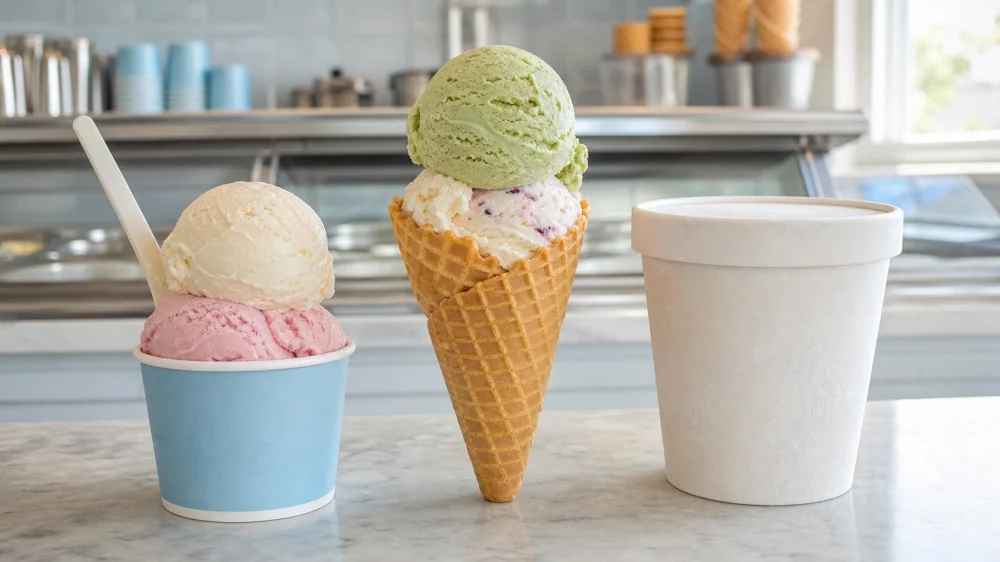
Cup, Cone, or Pint? How to Choose Your Ice Cream Order
On this page
Quick answer
Choose a cup for control, toppings, accessibility, or slower eating; a cone for an edible, portable treat you will eat promptly; and a pint for planned take-home sharing or multiple servings when cold storage is ready. Check portion size, cone ingredients, lid security, weather, travel time, and freezer access before paying. The best format is the one that fits how and where you will eat it.

The Ice Cream Shoppe / ice cream shop shelton
SheltonNaugatuck Valley Planning RegionConnecticut
59 Bridgeport Ave, Shelton, CT 06484, USA
Start with the eating situation
The same ice cream can create a different experience in a cup, cone, or take-home container. The useful question is not which format is universally better. It is which one matches the eater, setting, temperature, texture, and time available.
Ask five questions:
- Will you eat it inside, walk with it, drive with it, or take it home?
- How quickly can you comfortably finish it?
- Do you want toppings, multiple flavors, or a clean tasting sequence?
- Do allergies, mobility, sensory, dental, or dexterity needs affect the container?
- Will leftovers have reliable freezer space soon?
Availability varies by shop. A “pint” may be hand-packed or prepacked, a cone may hold fewer flavor combinations, and cup sizes may not correspond directly to scoop counts. Read the current menu and ask how the specific shop portions each format.

Venchi Chocolate & Gelato Columbus Circle / venchi columbus circle
New YorkNew York CountyNew York
1796 Broadway, New York, NY 10019, USA
When a cup is the best fit
A cup is usually the most controlled option. It keeps melting ice cream contained, works with a spoon, and accommodates sauces, crumbs, fruit, nuts, whipped toppings, or several textures without relying on the cone wall.
Choose a cup when:
- You plan to sit and eat slowly.
- The weather is hot, windy, or rainy.
- You need one hand free only after reaching a table.
- You want toppings that would slide off a cone.
- You prefer not to bite a cold or crunchy cone.
- A child needs help containing drips.
- Holding and rotating a cone would be difficult.
A cup is not automatically mess-free. Overfilling, a loose lid, a shallow spoon, or walking on an uneven surface can still cause spills. Ask for a lid only if you will use it; otherwise it becomes unnecessary waste.
When to choose a cone
A cone combines container and snack. It can be convenient for walking, adds crisp texture, and leaves less packaging when fully eaten. It works best when the serving is stable, the eater can manage drips, and the ice cream will be finished soon.
Common styles include cake cones, sugar cones, waffle cones, and specialty alternatives. They differ in width, strength, sweetness, texture, and ingredients. A wide waffle cone may suit a larger scoop but can become fragile as melting ice cream reaches the rim.
Choose a cone when you want the edible contrast and can:
- Eat before significant melting occurs.
- Hold it upright without setting it down.
- Manage the portion while walking or standing.
- Confirm the cone fits dietary and allergy needs.
- Keep wrappers or sleeves out of the environment.
A cone is not ideal in a moving vehicle, near sensitive equipment, during very hot conditions, or for someone who needs both hands for mobility support. Use a cup without treating it as a lesser experience.
When a pint makes more sense
A take-home pint or similar container is useful when the goal is later eating rather than an immediate single serving. It can support sharing, several small portions, dessert pairing, or enjoying a flavor unavailable in stores.
Choose take-home packaging when:
- A working freezer is ready at the destination.
- The travel time and outdoor temperature allow safe frozen transport.
- You have an insulated cooler or other shop-recommended method when needed.
- The lid seals securely and the container can stay upright.
- The group agrees on flavors and allergen considerations.
Do not choose a pint simply because it looks like better value. Compare the actual quantity, quality, intended servings, and likelihood of finishing it. Repeated softening and refreezing can damage texture and may create food-safety concerns if the product warms excessively. Follow the shop or manufacturer storage guidance.
A fast ordering checklist
- Pick the format first. Decide whether you are eating now, walking, or taking dessert home.
- Confirm portion language. Ask whether the menu uses scoops, cup sizes, weights, or fixed prepacked containers.
- Choose flavors that fit. Some cones or cups cannot safely hold several dense scoops or heavy toppings.
- Check ingredients. Ask separately about the ice cream, cone, toppings, utensils, and cross-contact process.
- Plan the handoff. Have a table, napkin, carrier, or cooler ready before the order is served.
- Limit extras. Accept only spoons, lids, sleeves, and bags you expect to use.
- Inspect before leaving. Confirm the order, container stability, lid, and any requested allergen communication.
Allergies, portions, and waste
Container choice does not eliminate allergen risk. Cones may contain wheat, milk, egg, soy, nuts, or other ingredients, and shared scoops, topping wells, counters, utensils, and storage can create cross-contact. Ask the shop what it can verify. If the risk cannot be managed to your needs, do not rely on a cup alone as protection.
For children and anyone with swallowing, sensory, or motor needs, select a manageable portion and stable seating. Watch for melting, choking hazards in hard toppings, and sharp broken cone edges. The responsible adult should decide whether the format is appropriate.
Reduce waste by ordering the portion you expect to finish and accepting only necessary packaging. Dispose of cups, spoons, napkins, wrappers, and food residue according to local bins. Even compostable items may require a specific commercial system and do not belong on streets or trails.
Limitations and evidence notes
This comparison uses general frozen-dessert service and food-handling principles. Shops across the United States differ in serving sizes, container materials, ingredients, allergen procedures, prices, return policies, and storage advice. Current staff guidance and product labels are stronger evidence than a generic category description.
Food texture and melting depend on recipe, serving temperature, air content, stabilizers, ambient conditions, and handling. A format cannot guarantee slower melting or better quality. For medically diagnosed allergies or other health needs, follow individualized professional guidance and make decisions based on what the shop can reliably confirm.
Frequently asked questions
Does a cone hold more ice cream than a cup?
Not necessarily. Shops portion by scoop, weight, or container size. Ask whether equivalent menu sizes contain the same amount rather than judging by appearance.
Is a cup better in hot weather?
It usually contains drips more effectively, but the ice cream still melts. Eat in shade or air conditioning when available and avoid leaving it in a hot vehicle.
Can I ask for a cone on top of a cup?
Many shops can provide this, letting you control drips while keeping the cone texture. Ingredient and cross-contact questions still apply, and the extra cup may create more waste.
Should I buy a pint for one person?
It can make sense for planned portions over time if storage is reliable. Confirm the container size, take it directly to a freezer, and use clean utensils rather than repeatedly eating from and warming the entire container.
Which option is easiest for multiple flavors?
A wider cup often separates flavors and toppings more securely, but the shop may limit combinations by size. Ask which format supports the number of flavors you want.
Conclusion and next steps
Use the eating situation to choose: a cup for control and toppings, a cone for an immediate edible package, or a pint for planned take-home servings. Confirm portions and ingredients, match the format to mobility and weather, and prepare the table or freezer before handoff. A practical choice keeps the focus on flavor instead of spills, waste, or rushed storage.


 Kettlewell's4.0 (31 reviews)
 Reedsville Creamery Ice Cream Stand4.0 (115 reviews)
 The Snack Shack4.0 (560 reviews)
 Piñas Locas4.0 (25 reviews)
 Charlie & Munco’s4.0 (29 reviews)
 Kohr Brothers Frozen Custard4.0 (88 reviews)
 Best Ice Cream Shops in Branson for Missouri Ozark Hillbilly Themes
 How to Get the Perfect Scoop Every Time: Ice Cream Tips from the Pros
 How to Make Ice Cream with Feijoa for a New Zealand Pineapple Guava Twist
 What Is Birthday Cake Ice Cream and How to Make It at Home
 How to Make Ice Cream with Camu Camu for the Highest Vitamin C Content
 Ice Cream Parlor Secrets: How the Best Ice Cream Shops Make Their Treats