
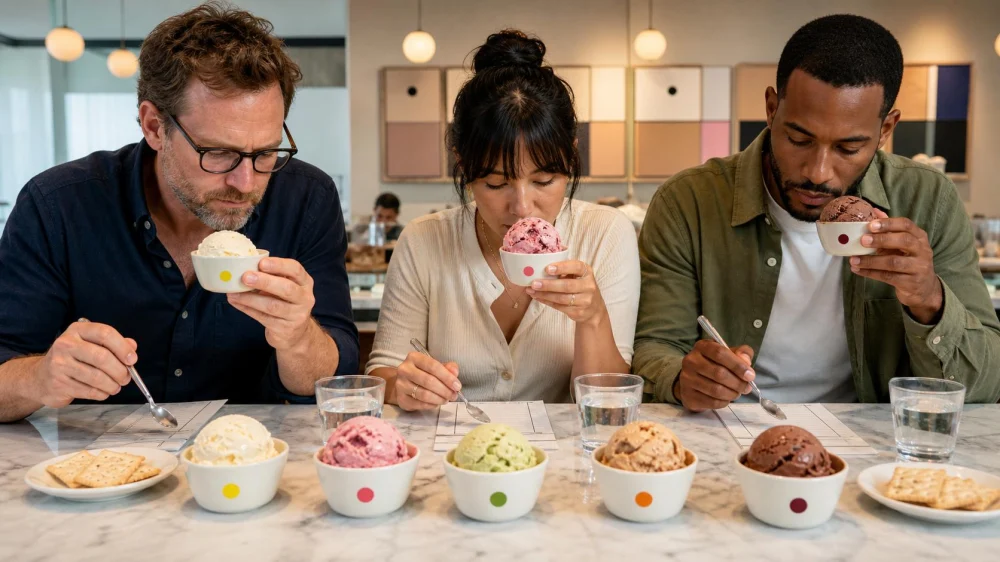
How to Taste Ice Cream: Temperature, Aroma, and Texture
Table of contents
Quick answer
To taste ice cream thoughtfully, start with a small clean serving that is cold but scoopable, notice its appearance and aroma, then let a bite warm briefly on the tongue before chewing mix-ins. Track sweetness, dairy or base flavour, texture, aftertaste, and melt. Compare lighter flavours before intense ones, use water and a plain cracker between samples, and keep extra ice cream safely frozen.

Jones' Homemade Ice Cream Shoppe / jones' homemade ice cream shoppe baldwin menu
858 Michigan Ave, Baldwin, MI 49304, USA
Set up a fair tasting
A good tasting controls simple variables so the ice cream—not the bowl, freezer burn, or a strongly flavoured spoon—drives the result. Use clean neutral bowls and metal or plain reusable spoons. Serve similar-size samples and label them with codes if you want a blind comparison.
- Work in a room without strong cooking, candle, or perfume aromas.
- Use bright neutral light to see colour and inclusions.
- Serve water at a comfortable temperature.
- Offer plain crackers or bread between rich samples.
- Limit the number of flavours so palate fatigue does not flatten differences.
- Keep containers out only as long as needed to portion them.
Let temperature reveal flavour
Very hard ice cream can feel less aromatic and more painfully cold, while an overly melted sample loses structure. Aim for a state where a spoon enters cleanly and the sample begins to soften at the edge without turning soupy.
Do not use a microwave to race toward tasting temperature; hot spots can melt part of the product while the centre remains hard. Instead, portion a small sample and let it temper briefly under observation. Return the main container to the freezer.
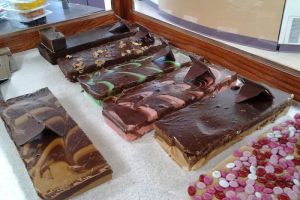
Sweet Temptations / temptations grand haven
Grand HavenOttawa CountyMichigan
621 Miller Dr, Grand Haven, MI 49417, USA
A step-by-step tasting sequence
- Look. Notice colour, air pockets, ice crystals, swirl distribution, and mix-in size without deciding quality from appearance alone.
- Smell. Bring the sample near the nose and note dairy, vanilla, cocoa, fruit, nut, spice, roast, or caramel aromas.
- Take a small bite. Let it sit briefly so temperature rises and flavour becomes easier to perceive.
- Notice the base. Is the first impression milky, custardy, fruity, chocolate-forward, plant-based, or something else?
- Assess balance. Consider sweetness, bitterness, acidity, salt, roast, and flavour intensity.
- Feel the texture. Note smoothness, density, iciness, stretch, gumminess, or waxiness.
- Chew inclusions. Evaluate crunch, softness, size, and how mix-ins change the base.
- Watch the finish. Record flavour length, coating, and any clean, bitter, fruity, or stale aftertaste.
Read the texture
Texture is shaped by ice crystals, air, fat or other solids, sugars, stabilisers, recipe, freezing, storage, and serving temperature. “Dense” is not automatically better than “light,” and a chewy style is not automatically defective. Judge whether the texture fits the product’s intended style.
Large obvious ice crystals can suggest temperature fluctuation or age, but crunchy ingredients may create a deliberate contrast. Let crystals melt: ice disappears quickly, while sugar, candy, or cookie pieces retain their own flavour and structure.
Evaluate swirls and mix-ins
Take one bite mostly from the base and another with the swirl or pieces. This reveals whether the base is satisfying alone and whether inclusions overwhelm it. Check distribution across the serving rather than judging a single lucky spoonful.
- Does a sauce remain distinct or vanish into sweetness?
- Are nuts and cookies crisp, pleasantly softened, or stale?
- Are pieces small enough to eat when frozen?
- Does salt or acidity give contrast?
- Does each bite feel coherent, or do components compete?
Compare several flavours
Move from delicate to intense: simple dairy or vanilla, then fruit, caramel or nut, then dark chocolate, coffee, mint, smoke, spice, or high-alcohol flavours. This is a useful default, not a rigid law. If one sample is especially bold, revisit the earlier flavour after water and a short break.
For a blind tasting, have someone else code the bowls. Record first impressions before discussing them; group comments can influence perception.
Use a simple scorecard
- Appearance and aroma
- Base flavour clarity
- Sweetness and flavour balance
- Smoothness and body
- Mix-in quality and distribution
- Melt and aftertaste
- Personal enjoyment
Use descriptive words before a number. “Bright berry with a clean tart finish” is more useful than “eight out of ten.” Separate preference from execution: you can recognise a well-made mint flavour without personally choosing it.
Limits and food safety
Tasting cannot determine microbiological safety, ingredients, or allergen cross-contact. Read packaging and ask the shop about ingredients and preparation. Keep frozen products at safe freezer temperatures, use clean utensils, and discard ice cream left warm or contaminated according to official food-safety guidance. People with food allergies, immune compromise, pregnancy, or other dietary risks should follow their clinician and FDA advice.
Frequently asked questions
Should I taste from the container?
Use a clean bowl and spoon. Double-dipping introduces contamination and repeatedly warms the container.
Why does the same ice cream taste sweeter when softer?
Extreme cold suppresses some sensory perception. As the sample warms, aroma and sweetness may become easier to notice.
How many flavours should I compare?
Start with three or four. More samples can tire the palate and allow melting to outpace evaluation.
Is a slow melt always better?
No. Recipe and style affect melt. Evaluate whether it remains pleasant and cohesive at a normal serving pace.
Sources and evidence
Ice cream structure reflects the interaction of ice, air, fat, sweeteners, milk solids or alternatives, and stabilising ingredients; product formulation and temperature therefore influence flavour release and texture. For consumer handling, use FDA’s food storage guidance and the product label. Ingredient and allergen questions must be verified with the shop or manufacturer.
Next steps
Choose three contrasting flavours, portion small equal samples, and taste from light to bold. Write one line each for aroma, balance, texture, mix-ins, and finish—then compare notes only after everyone has formed an opinion.

 Custard King4.0 (259 reviews)
 Meusel's Dairy Delite4.0 (200 reviews)
 Lajtis lunchBox LLC4.0 (9 reviews)
 Dairy Queen (Treat)4.0 (160 reviews)
 Miss Twist4.0 (442 reviews)
 Dino's ice cream & Italian water ice4.0 (150 reviews)
 Best Ice Cream Shops in Moab for Utah Desert Rock Formations
 The Ultimate Guide to Ice Cream: From Ancient China to Modern America
 What Is Birthday Cake Ice Cream and How to Make It at Home
 Best Places to Get Ice Cream in San Francisco with Bay Views
 Best Ice Cream Shops in Boston for Historic and New England Flavors
 How to Make Ice Cream with Bergamot for an Earl Grey Scent