
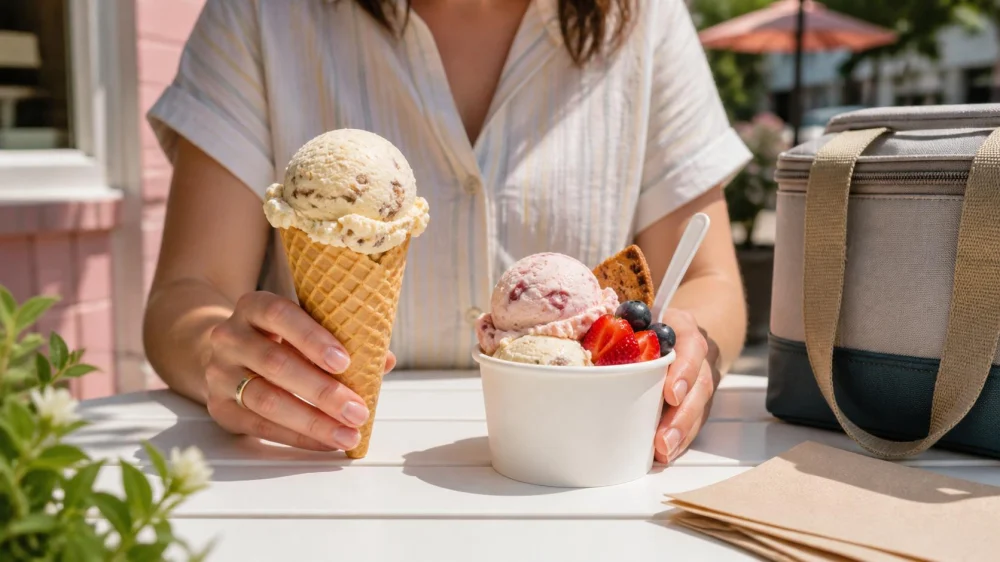
Ice Cream Cone or Cup: Choose for Heat, Toppings, and Travel
On this page
- Start with how you will eat
- Compare melting and mess
- Match the container to the scoop
- Plan toppings and sauces
- Check cone ingredients and allergens
- Choose for children and access needs
- Prepare for walking or driving
- Reduce waste without creating a mess
- Order clearly at the counter
- Fix common serving problems
- Cone or cup checklist
Choosing between an ice cream cone and a cup is not only a matter of taste. Weather, scoop texture, toppings, allergies, hand strength, walking distance, and the need to share can all change which container works better. The same person may prefer a crisp cone indoors and a lidded cup on a hot outdoor trip.
A quick look at how and where you will eat makes the choice easier. This guide compares the practical tradeoffs so you can order a serving that stays manageable from the counter to the last bite.

Lake Erie Scoops / lake erie scoops
6604 Detroit Ave, Cleveland, OH 44102, USA
Start with how you will eat
Think about the next fifteen minutes. Will you sit at a table, walk through a crowded area, supervise a child, carry bags, use mobility equipment, or get into a vehicle? A cone requires one hand and steady attention as it melts. A cup can rest on a table and may accept a lid, but it needs a spoon.
Consider whether you want to eat the container. A cone adds flavor and texture, while a cup keeps the ice cream separate and makes it easier to pause. If the shop is busy, decide before reaching the register and identify a safe place to stand or sit after pickup.

Baskin-Robbins / baskin robbins rockford
RockfordWinnebago CountyIllinois
Brynwood Square Shopping Ctr, 2579 N Mulford Rd, Rockford, IL 61114, USA
Compare melting and mess
Heat, sun, wind, and soft ice cream accelerate dripping. A wide cup contains melted edges and lets you stir them back into the serving. A cone can stay neat when the portion is firm and eaten promptly, but drips may travel down the cone before you notice.
Ask for a cup beneath a cone if the shop offers one, especially for multiple scoops or outdoor eating. This adds a disposable item, so use it when it solves a real problem rather than automatically. Napkins are helpful, but wrapping the whole cone too tightly can hide drips until the paper becomes wet.
Match the container to the scoop
Dense, firm ice cream can balance differently from soft serve, gelato, or a very soft scoop. A narrow cone may not support several large scoops or chunky mix-ins. A cup can hold irregular pieces and lets the server place each flavor side by side or stacked, depending on size.
Ask which cone and cup sizes are designed for the number of scoops you want. Do not request an unstable portion for a photograph or challenge. If a server recommends a larger container, it is usually because the base needs enough room to support the serving.
Plan toppings and sauces
Loose nuts, candy pieces, cereal, fruit, and cookie crumbs need a rim to keep them from falling. Sauces can run down a warm cone or soften it. A cup is usually easier for layered toppings, several sauces, or a spoonful in every bite.
A dipped or coated cone can add its own crunch without a pile of toppings, but it may contain additional allergens and can crack. Ask whether toppings are pressed onto the scoop, layered in the cup, or served separately. Choose fewer additions when the goal is to taste a delicate flavor clearly.
Check cone ingredients and allergens
The cone is part of the food order. Waffle, sugar, cake, chocolate-coated, gluten-free, and specialty cones can contain different ingredients. A cone labeled free from one ingredient may be stored, handled, or prepared near other allergens.
Tell staff about an allergy before ordering and ask about the current ingredient information and cross-contact process for the ice cream, cone, scoop, toppings, and equipment. A cup does not automatically eliminate cross-contact. If the shop cannot meet your needs, choose a sealed product with a suitable label or do not order.
Choose for children and access needs
A small cup may be easier for a young child because an adult can set it down, help with the spoon, and see melting before it reaches clothing. If a cone is chosen, use a portion the child can manage and stay nearby. Avoid hard toppings or pieces that are not appropriate for the eater.
People with limited grip, tremor, fatigue, low vision, or other access needs may prefer a stable cup, larger spoon, tray, lid, or table service. Others may find a cone easier than coordinating a spoon. Ask what packaging and utensils are available rather than assuming one option is universally accessible.
Prepare for walking or driving
A passenger can manage a lidded cup more safely than an open cone, but the best plan is to eat before the vehicle moves or transport the item in an insulated cooler. The driver should never hold, unwrap, or eat melting ice cream while driving.
For a longer walk, choose a smaller serving, remain in shade, and know where waste and handwashing facilities are located. Do not leave ice cream in a hot vehicle or carry it around for an extended period. For pints or multiple servings, use insulated transport and return them to a freezer promptly.
Reduce waste without creating a mess
An edible cone can reduce packaging when it suits the order and will be eaten. A cup may prevent a spill that wastes the entire serving and requires cleaning materials. The lower-waste choice depends on what you can handle successfully, not only the number of items handed across the counter.
Take only the napkins and utensils you expect to use. Ask whether the shop has reusable dine-in containers or locally accepted recycling or composting, but follow the actual disposal labels. Food-soiled paper, coated cups, and mixed materials may not belong in the same stream.
Order clearly at the counter
State the size, flavors, cone or cup, topping choices, and any separate requests in a consistent order. For example: “one scoop of vanilla in a small cup, sauce on the side.” Ask about price differences, premium flavors, and added charges before confirming.
If you want a cone placed in a cup, clarify whether you mean an empty cone on top, a side cone, or the scoop served in the cone with a catch cup. Shops use different language. Review the finished order before walking away and ask for a lid only if the cup has room without crushing the serving.
Fix common serving problems
If a cone begins dripping, move to a stable spot and use a napkin around the base without squeezing. Eat around the melting edge evenly or transfer the cone into a cup if one is available. If the scoop becomes unstable, do not try to toss or rebalance it while walking.
For a cracked cone noticed at pickup, ask staff for a cup. If the order contains the wrong flavor or an allergen concern, do not taste it to check; speak with staff immediately. For a spill, keep people away from the slippery area and notify an employee rather than leaving it for the next customer.
Cone or cup checklist
- Decide whether you will sit, walk, share, or travel.
- Consider heat, sun, wind, and the scoop's softness.
- Match the container size to the number of scoops.
- Use a cup for loose toppings or generous sauces.
- Check ingredients and cross-contact for every component.
- Choose a stable format for children and access needs.
- Keep the driver free from eating or handling the order.
- Take only necessary packaging, napkins, and utensils.
- State size, flavor, container, and toppings clearly.
- Report spills or incorrect orders before leaving.
A cone adds crunch and fun when the serving is stable and you can eat it promptly. A cup offers control for heat, toppings, pauses, and travel. Choose for the situation rather than habit, confirm allergen information, and keep the portion manageable. The right container is the one that lets you enjoy the ice cream without racing the melt.





 Carvel4.0 (46 reviews)
 Dairy Queen (Treat)4.0 (348 reviews)
 Baskin-Robbins3.0 (35 reviews)
 Frozen Therapy3.0 (11 reviews)
 Wilson's Restaurant & Ice Cream Parlor4.0 (2489 reviews)
 Man Dairy Bar4.0 (146 reviews)
 Best Ice Cream Shops in Columbus for Ohio State University Fans
 Ice Cream Melting Fast? Here’s Why and How to Prevent It
 Ice Cream and Philosophy: The Ethics of Indulgence vs. Moderation
 What Is Orange Julius Ice Cream and How to Recreate the Mall Favorite
 Ice Cream and Survival: How to Make Ice Cream in the Wilderness
 Top Ice Cream Shops in Portsmouth with New Hampshire Coastal Vibes