
Ice Cream Sandwich Guide: Cookies, Texture, and Storage
On this page
- Quick answer
- Build a balanced sandwich
- Choose a cookie that stays biteable
- Match the frozen filling
- Control thickness and portion
- Use coatings and edge toppings wisely
- Questions to ask at an ice cream shop
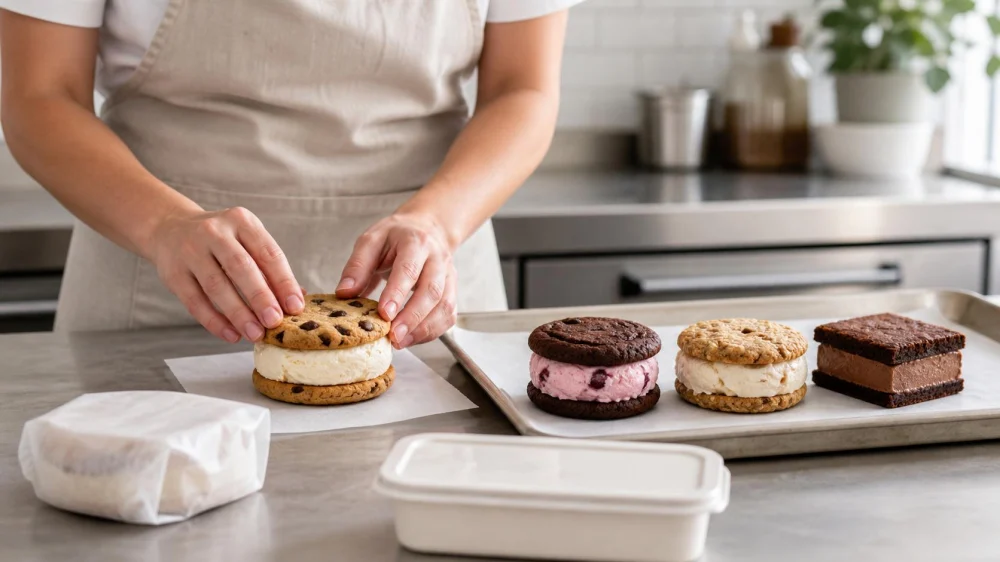
- A simple home assembly method
- Wrap and store for better texture
- Serve and transport without a mess
- Frequently asked questions
- Conclusion and next steps
Quick answer
A good ice cream sandwich uses two cookies that stay firm enough to hold the filling but soft enough to bite when frozen. Match cookie sweetness and flavor to the ice cream, keep the filling even, and avoid an overly thick center. Wrap sandwiches individually, freeze them flat in a sealed container, and let them soften briefly under supervision before eating if the cookies are too hard.
Texture depends on the exact cookie, frozen filling, storage temperature, and time. Shop-made and homemade sandwiches may contain common allergens, so confirm ingredients and cross-contact before ordering or serving.
Summer's Best Ice Cream / summers best johnstown ny
JohnstownFulton CountyNew York
24 Briggs St, Johnstown, NY 12095, USA
Build a balanced sandwich
The cookie supplies structure, chew, salt, and baked flavor. The ice cream adds coldness, creaminess, and most of the moisture. A successful pair lets both parts remain distinct while still yielding in one bite.
Consider four balances: soft versus crisp, sweet versus salty, plain versus strongly flavored, and thin versus substantial. Two very sweet components can become tiring, while a highly crisp cookie around very hard ice cream may squeeze the filling out.

Cold Stone Creamery / cold stone ashburn
42385 Ryan Rd Spc 23, Ashburn, VA 20148, USA
Choose a cookie that stays biteable
Cookies change in the freezer. Thin crisp cookies may become brittle or absorb moisture and soften. Thick cakey cookies may freeze hard if low in fat or moisture. Chewy cookies often remain more biteable, but recipes vary.
- Chocolate chip: familiar, chewy, and compatible with many fillings.
- Brownie-style: rich and soft but can make a dense sandwich.
- Oatmeal: textured and sturdy; spices influence the pairing.
- Shortbread: buttery and crisp, best when not excessively thick.
- Wafer: neat and light but may soften over time.
- Ginger or spice cookie: bold enough for vanilla, caramel, or fruit fillings.
Match the frozen filling
Dense ice cream creates a rich center but may need a short softening period before assembly. Soft serve is easy to spread but requires rapid freezing and can form a lighter center. Gelato, frozen custard, sorbet, and plant-based desserts have different fat, sugar, water, and air levels, which affect hardness and melting.
Use a flavor that complements rather than hides the cookie. Vanilla can highlight a strongly flavored cookie, while a simple chocolate cookie can support fruit, coffee, mint, caramel, or nut flavors. Consider swirls and chunks because large pieces can create weak spots.
Control thickness and portion
A filling layer close to the cookie thickness is a practical starting point, but there is no required ratio. A very thick center can be difficult to bite before melting, while a thin layer may disappear behind the cookie.
Keep the ice cream level and extend it close to the edges. Uneven filling makes one side squeeze out first. For easier serving, make smaller sandwiches or cut a large one with a suitable clean knife before it becomes too hard.
Use coatings and edge toppings wisely
Rolling exposed edges in fine crumbs, mini chips, chopped nuts, sprinkles, or toasted coconut adds texture and appearance. Large, hard pieces can fall off or make biting awkward. Apply toppings while the filling is soft enough to hold them, then freeze promptly.
A partial chocolate coating can slow drips at one edge, but it also becomes firm when cold. Keep the layer thin enough to bite. Ask about allergens in every coating and topping, not only the cookie and ice cream.
Questions to ask at an ice cream shop
- Is the sandwich preassembled or made to order?
- Which cookie and ice cream combinations are available?
- Does it need a few minutes to soften before eating?
- Can it be cut or wrapped for sharing?
- How long can it travel before needing a freezer?
- What ingredients and cross-contact risks apply?
- Are coatings or edge toppings included?
If transporting several, ask for insulated packaging and keep the box level.
A simple home assembly method
- Cool baked cookies completely so residual warmth cannot melt the filling.
- Pair cookies of similar size and place the flat sides inward.
- Soften ice cream only enough to portion or spread, keeping the remainder frozen.
- Add an even layer to one cookie and press the second cookie gently on top.
- Smooth the edge with a clean spoon and add fine toppings if desired.
- Wrap immediately and freeze the sandwich flat until firm.
Work in small batches. Do not repeatedly soften and refreeze the same container, and keep hands, tools, and surfaces clean.
Wrap and store for better texture
Wrap each firm sandwich closely with freezer-safe material, then place it in a sealed container. Individual wrapping limits air exposure, odor transfer, freezer burn, and sandwiches sticking together. Label the container with the assembly date and allergen information when serving others.
Texture is usually best sooner rather than after a long storage period. Follow the ingredient manufacturers’ storage guidance, keep the freezer at a safe temperature, and discard sandwiches affected by a freezer failure or uncertain handling.
Serve and transport without a mess
Move one sandwich at a time from the freezer. If the cookie is too hard, let it stand briefly on a clean plate while watching the texture. Do not microwave it; the edges can melt while the center remains hard.
For transport, pre-freeze the sandwiches, use a clean insulated cooler with adequate frozen packs, keep it closed and shaded, and transfer the food to a freezer promptly. A cooler slows warming but does not make indefinite travel safe.
Frequently asked questions
Why do my cookies get hard in the freezer?
Cookie recipe, thickness, moisture, fat, and freezer temperature all matter. A thinner chewy cookie or a short supervised softening period may improve biteability.
Why does the ice cream squeeze out?
The filling may be too soft or thick, or the cookies may require too much biting pressure. Refreeze the sandwich flat and reconsider the proportions.
Can I use warm cookies?
No. Warm cookies melt the filling and can create uneven refreezing. Cool them completely before assembly.
Can sorbet work in an ice cream sandwich?
Yes, but its hardness and melting behavior differ from dairy ice cream. Pair it with a cookie that remains easy to bite and test one sandwich first.
Conclusion and next steps
Start with a cookie that remains biteable when cold, pair it with a complementary filling, and keep the center even and manageable. Use fine edge toppings, wrap each sandwich tightly, freeze flat, and move it from freezer to plate only when ready. For shop orders, ask about softness, transport time, and all ingredients before choosing.





 Baskin-Robbins0.0 (0 reviews)
 JJ's Custard Company - Dearborn Heights4.0 (140 reviews)
 Cool Joint Ice Cream4.0 (68 reviews)
 Dairy Queen (Treat)4.0 (255 reviews)
 Rita's Italian Ice & Frozen Custard4.0 (139 reviews)
 South Side Scoops4.0 (258 reviews)
 Best Ice Cream Shops in Indianapolis for Hoosier Hospitality
 Best Ice Cream Shops in Chicago for Classic and Artisan Flavors
 How to Make Ice Cream with Fennel for a Unique Anise Flavor
 Ice Cream and Space Exploration: How Astronauts Eat Ice Cream
 Ice Cream and Photography: Tips for Stunning Dessert Photos
 How to Make Mexican Enchiladas with a Delicious Homemade Sauce