

Ice Cream Shop Allergy Questions Before You Order
On this page
- Quick answer
- Prepare before the visit
- Ask ingredient-specific questions
- Map the cross-contact points
- Compare common ice cream orders
- Use a clear counter conversation
- Check packaged options separately
- Keep the emergency plan available
- Limitations and important notes
- Frequently asked questions
- Sources and evidence notes
- Next steps
Quick answer
Before ordering at an ice cream shop with a food allergy, identify the exact flavor, base, mix-ins, cone, sauce, and topping, then ask how each is stored and served. Confirm shared scoops, rinse water, soft-serve machines, blenders, counters, and gloves. If staff cannot verify an ingredient or process, do not treat the item as allergy-safe.
This guide is for U.S. customers with diagnosed food allergies and their caregivers. It helps organize questions; it cannot determine whether a product is safe for one person. Follow the individual avoidance and emergency plan provided by a qualified healthcare professional.

Ellen's Homemade Ice Cream / ellen's homemade ice cream charleston wv
CharlestonKanawha CountyWest Virginia
225 Capitol St, Charleston, WV 25301, USA
Prepare before the visit
Start with the shop’s current official menu, ingredient page, or allergen information. A social media photo, review, or old menu can be useful for ideas, but it is not a reliable ingredient record. Recipes, brands, suppliers, seasonal flavors, and toppings can change.
Write down the allergen by its specific name. “Nut allergy” may be too broad when the person needs to distinguish peanuts from particular tree nuts. The nine major allergens recognized in U.S. federal food law are milk, egg, fish, Crustacean shellfish, tree nuts, peanuts, wheat, soybeans, and sesame. A person can also be allergic to a food outside that list, so a standard major-allergen chart may not answer every question.
Choose one or two possible orders before reaching the counter. For each option, list every component:
- ice cream, gelato, frozen custard, sorbet, or soft-serve base;
- swirls, cookie pieces, candy, nuts, fruit, or other mix-ins;
- cake cone, sugar cone, waffle cone, cup, lid, and spoon;
- hot fudge, caramel, fruit sauce, whipped topping, or sprinkles;
- garnishes placed on the finished order;
- any blender, mixer, scoop, or machine used during preparation.
Call during a less busy time if the website does not answer the questions. Ask whether an owner, manager, or trained employee can review ingredients and preparation. A phone answer is still only a starting point: confirm the item and process at the location when you arrive.

Scoopers Ice Cream / scoopers waupaca
WaupacaWaupaca CountyWisconsin
E1209 County Q, Waupaca, WI 54981, USA
Ask ingredient-specific questions
Tell the employee, “I have a food allergy,” and name it. Do not describe a medical allergy only as a dislike, sensitivity, diet, or preference. Then ask about one specific product rather than requesting anything “allergy-friendly.”
A useful question is: “Does the vanilla ice cream contain egg, and can I see the current container or ingredient record?” Follow with questions about the cone, toppings, and preparation. If a base comes from a supplier, the shop may have a product label, specification sheet, or allergen chart. If it is made in-house, ask whether the complete recipe and every mix-in can be verified.
Pay attention to compound ingredients. Cookie dough, brownie pieces, cheesecake chunks, pralines, sauces, and candy can introduce several allergens. A flavor name does not reveal every ingredient. “Chocolate,” “birthday cake,” or “butter pecan” is not enough information to make an allergy decision.
Also ask whether today’s product is the usual one. A substitute cone, new candy brand, temporary topping, or reformulated base can make an old answer inaccurate. If staff rely on memory and cannot locate current information, consider that uncertainty part of the decision.
Map the cross-contact points
Cross-contact is the unintended introduction of an allergen into another food. It can occur even when the allergen is not part of the recipe, and it is not necessarily corrected by removing a visible topping. Ice cream shops have several recurring contact points.
Shared scoops and rinse water
A scoop may move from one tub to another or sit in shared rinse water. Pieces of cookies, nuts, candy, or cone can also fall into nearby containers. Ask whether the shop has a verified procedure for a clean scoop, clean gloves, and a container that has not been exposed at the serving surface. A fresh scoop alone does not address a tub that already contains stray mix-ins.
Open topping bars and counters
Spoons can migrate between topping bins, and crumbs can scatter across the counter. Self-service topping bars add customer handling that employees may not be able to trace. Ask whether toppings are stored separately in covered containers and whether a clean portion can be taken according to the shop’s established procedure.
Soft-serve and frozen dessert machines
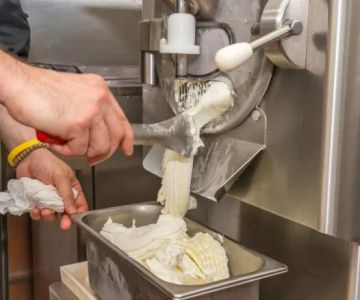
Separate handles do not prove separate internal food paths. Flavors may share a machine, nozzle, hopper, cleaning system, or twist function. Ask the shop what is shared and whether the machine’s documentation supports the answer. Do not infer safety from the color or name of a flavor.
Milkshake blenders and mixers
Blenders and spindle mixers may process milk, peanut butter, nut-containing flavors, cookies, or other mix-ins. Rinsing may not be the shop’s full allergen-cleaning procedure. Ask whether dedicated equipment exists or whether the shop can perform a documented cleaning process before the order.
Cones, gloves, and final assembly
Employees may touch cones and then cups, or handle several orders with the same gloves. Cone crumbs can collect near tubs and work surfaces. Requesting a cup can remove one ingredient from the order, but it does not erase earlier contact. Ask how the complete order will be assembled.
Compare common ice cream orders
No order type is automatically safe. Each has different questions:
- Hand-scooped ice cream: verify the base, mix-ins, tub exposure, scoop, rinse water, gloves, and cup or cone.
- Soft serve: verify the mix label, hopper, internal paths, nozzle, twist function, cleaning process, and toppings.
- Milkshake: verify every ingredient plus the blender or mixer and any garnish.
- Sundae: check the frozen base, every sauce and topping, shared utensils, whipped topping, and assembly area.
- Sorbet or non-dairy dessert: verify ingredients and shared production or serving equipment. “Non-dairy,” “vegan,” and “plant-based” do not address all allergens or cross-contact.
- Sealed packaged item: read the current label on the exact package, check its integrity, and follow the individual medical plan.
A simpler order may reduce the number of ingredients and tools to verify, but simplicity is not a guarantee. Plain-looking flavors can still contain major allergens or share equipment with them.
Use a clear counter conversation
- Step aside from the main queue if the shop needs time to check information.
- State the food allergy and name the specific allergen.
- Ask for the employee who can verify ingredients and preparation.
- Name the exact flavor and every component you want.
- Ask about shared scoops, water, machines, surfaces, gloves, and toppings.
- Ask the shop to use its established allergy procedure; do not invent a process it cannot reliably perform.
- Repeat the final order and confirm it at handoff.
- Decline the order if the answer is “probably,” “I think,” or otherwise cannot be verified.
Do not ask an employee to promise “zero risk.” Ask what ingredients and processes apply, then use the person’s medical plan to decide whether the remaining uncertainty is acceptable. A shop that explains its limits is giving useful information.
Inspect the cup or cone before eating. Check that it is the correct flavor and that no unexpected sauce, crumbs, garnish, or topping appears. Visual inspection cannot detect all cross-contact; it is a final identity check, not proof of safety.
Check packaged options separately
U.S. packaged foods regulated by the FDA generally must identify major allergens used as ingredients. Read the entire ingredient list and any “Contains” statement on the package you are buying. Do this every time because formulations and suppliers can change.
Advisory phrases such as “may contain” are different from mandatory ingredient declarations and do not describe a universal level of risk. Follow the person’s clinician-guided plan for interpreting labels. A missing advisory statement is not a promise that cross-contact is impossible.
Ask whether the packaged item remained sealed and whether it is being served with a clean utensil or handed over in its original wrapper. If an employee opens, cuts, plates, or tops it, the shop’s equipment and counter become part of the assessment.
Keep the emergency plan available
Carry prescribed epinephrine or other emergency medicine exactly as directed and keep it accessible, not buried in a vehicle or bag. The person and companions should know the individualized action plan and how to use the prescribed device. Check storage and expiration requirements according to the product instructions.
If symptoms of an allergic reaction begin, stop eating and follow the emergency plan. For suspected anaphylaxis, use prescribed epinephrine promptly as directed and call 911. Emergency evaluation is still needed after epinephrine. Antihistamines are not a substitute for epinephrine in anaphylaxis.
Do not taste a questionable food to test it, and do not drive yourself during a reaction. Tell responders what was eaten, when symptoms began, and when medicine was given. Keep the receipt or product packaging if doing so does not delay care.
Limitations and important notes
Packaged-food labeling rules do not answer every question about food prepared and served in a retail shop. State and local restaurant requirements can differ, and a chain’s general allergen guide may not capture a location’s current supplier or handling.
Food allergy, food intolerance, celiac disease, and personal preference are not interchangeable. They may lead to different ingredient and cross-contact questions. This article does not diagnose a condition or define an acceptable exposure threshold.
No checklist can eliminate risk. If the shop cannot identify an ingredient, explain shared equipment, or carry out a process that fits the medical plan, choose another product or do not order.
Frequently asked questions
Is a plain vanilla cup the lowest-risk order?
Not automatically. Vanilla may contain milk, egg, soy, or another allergen, and the tub, scoop, rinse water, gloves, or counter may contact other flavors. Verify the exact product and preparation.
Does using a clean scoop solve cross-contact?
It addresses one tool only. The tub may already contain crumbs or residue, and the employee may touch shared surfaces, gloves, water, or containers. Ask about the full process.
Is sorbet safe for a milk allergy?
The name alone is not enough. Verify the recipe, supplier label, production equipment, scoop, storage, and serving area. Some products or processes may involve milk or other allergens.
Is vegan ice cream allergy-safe?
“Vegan” describes the exclusion of animal-derived ingredients; it does not exclude peanuts, tree nuts, soy, wheat, sesame, or cross-contact. Check every relevant allergen separately.
Can I rely on an online allergen menu?
Use the shop’s current official information as a starting point, then confirm the exact product and location. Seasonal flavors, substitutions, and local equipment can change the answer.
What if the shop cannot find the ingredient label?
Do not guess. Choose a sealed packaged option that fits the medical plan, visit another business with verifiable information, or skip the order.
Sources and evidence notes
- U.S. Food and Drug Administration: Food Allergies—What You Need to Know explains major allergens, labeling, symptoms, and emergency treatment considerations.
- FDA: Have Food Allergies? Read the Label explains how major allergens appear on packaged-food labels.
- FDA: Food Allergies defines allergen cross-contact and outlines the scope of federal labeling rules.
The practical questions in this guide apply those official principles to common ice cream shop equipment and ordering steps. They do not certify any shop, flavor, or process.
Next steps
Save the shop’s current official ingredient information, write one item-specific script, and list the equipment that matters for that order. Bring the individualized emergency plan and prescribed medication. At the counter, confirm every component and be prepared to choose a different option when information or procedures are uncertain.





 Graeter's Ice Cream4.0 (313 reviews)
 Baskin-Robbins3.0 (19 reviews)
 Cold Stone Creamery4.0 (240 reviews)
 La Michoacana Premium Grand Ave.4.0 (48 reviews)
 Sweet Werx4.0 (20 reviews)
 El Lounge Ice Cream Shop4.0 (64 reviews)
 The Science of Ice Cream: Why It’s So Addictive | Explore the Chemistry and Psychology
 Ice Cream and Innovation: New Freezing Technologies and Methods
 Ice Cream Art: How Sculptors Create Masterpieces from Frozen Dessert
 Ice Cream and Film: Famous Scenes Featuring Frozen Desserts
 What Is Chai Latte Ice Cream and How to Blend Spices with Black Tea
 Ice Cream and Literature: Famous Poems and Stories Featuring Dessert