
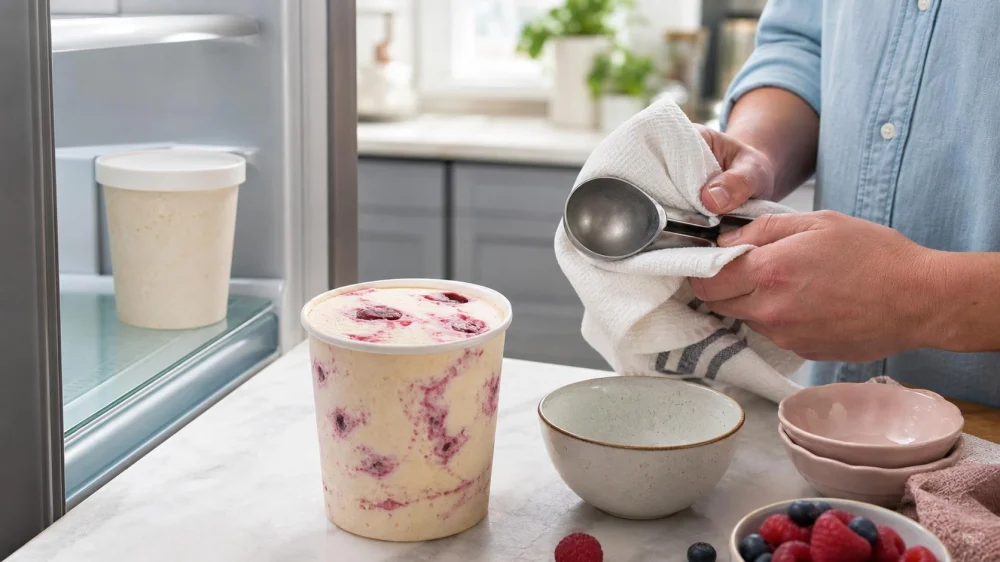
Ice Cream Too Hard? Soften It Without Ruining the Pint
On this page
Quick answer
Move the closed pint from the freezer to the refrigerator for a short, controlled rest, then check it frequently. If serving immediately, a brief counter rest can work, but return leftovers before the edges melt. Use a sturdy scoop warmed under water and dried. Avoid microwaving the carton or repeatedly melting and refreezing the whole pint.

Gannons Isle Ice Cream / gannons isle ice cream
SyracuseOnondaga CountyNew York
1525 Valley Dr, Syracuse, NY 13207, USA
Why ice cream gets hard
Freezer temperature, sugar, fat, air, stabilisers, alcohol, water content, and storage history affect hardness. A dense premium style or reduced-sugar recipe may need more tempering than a highly aerated product. Large ice crystals from temperature swings can make texture icy as well as firm.

Rita's Italian Ice & Frozen Custard / rita's freehold nj
FreeholdMonmouth CountyNew Jersey
47 W Main St, Freehold, NJ 07728, USA
Use a short controlled rest
- Read the package storage directions.
- Keep the lid closed while the pint rests in the refrigerator.
- Check at short intervals rather than setting one universal time.
- Press the centre gently with a clean spoon; scoop when it yields without liquid edges.
- Portion what will be eaten and return the rest promptly.
Room temperature varies, so condition—not a fixed minute count—is the safer guide.
Scoop and serve cleanly
Run a metal scoop under warm water, dry it, and pull across the surface in smooth strokes. Rewarm and dry between servings. A dry tool avoids adding water that freezes into crystals. Use a stable board under small or slippery containers.
Protect the remaining pint
Smooth the surface, close the lid tightly, and store the pint in a consistently cold part of the freezer rather than the door. Minimise time outside and avoid leaving the container open while people eat.
Methods to avoid
- Do not microwave a paper, plastic, foil-lined, or unknown container.
- Do not heat the scoop over a flame.
- Do not use a knife to pry out frozen chunks.
- Do not refreeze ice cream left warm for an extended period.
- Do not share scoops across flavours when allergens matter.
Serving checklist
Confirm serving count, temper the closed pint, prepare dry bowls and scoop, portion once, close promptly, and return leftovers to the coldest stable freezer area.
Important notes
Follow package directions and food-safety guidance. Discard ice cream with an unsafe storage history, broken seal, unusual odour, or signs of contamination. People managing food allergies need separate utensils and shop-specific cross-contact information.
Evidence notes
The method follows basic frozen-dessert quality principles: limit temperature cycling, avoid added surface water, temper gradually, portion efficiently, and restore stable frozen storage. The product label and manufacturer are primary sources for a specific recipe and package.
Frequently asked questions
How long should a pint sit out?
There is no universal time. Check frequently and stop before edges liquefy.
Can I microwave ice cream?
Avoid microwaving the original container; it heats unevenly and packaging may be unsuitable.
Why is one brand harder?
Recipe, air content, density, and storage temperature differ.
Does hot water on the scoop help?
Warm water helps, but dry the scoop before contact.
Can softened ice cream be refrozen?
Promptly return a pint that only softened slightly; discard it when storage time or temperature is unsafe or unknown.
Next steps
Temper the closed pint gradually, prepare a warm dry scoop, serve the needed portions, and return the container promptly. Note the successful method for that recipe and freezer.


 Breeze Cafe4.0 (110 reviews)
 Dairy Queen (Treat)4.0 (208 reviews)
 Los Jazmines De Michoacan4.0 (25 reviews)
 Arctic Ice Cream4.0 (53 reviews)
 Rice Culture - Stuffed Waffles & Soft Serve4.0 (91 reviews)
 Briq's Soft Serve4.0 (673 reviews)
 Ice Cream and Parenting: How to Make Healthy Versions for Kids
 Best Ice Cream Shops in Nashville for Hot Chicken Spiked Ice Cream
 How to Quick-Freezing Ice Cream Without Crystals
 Best Ice Cream Shops in Jefferson City for Missouri Ozark Flavors
 Ice Cream and Social Responsibility: Ethical Sourcing and Fair Trade | Ice Cream Shop
 How to Make Ice Cream with Coconut Sugar for a Caramel Note