
Soft Serve vs. Hard Scoop Ice Cream: Choose by Texture
On this page
Quick answer
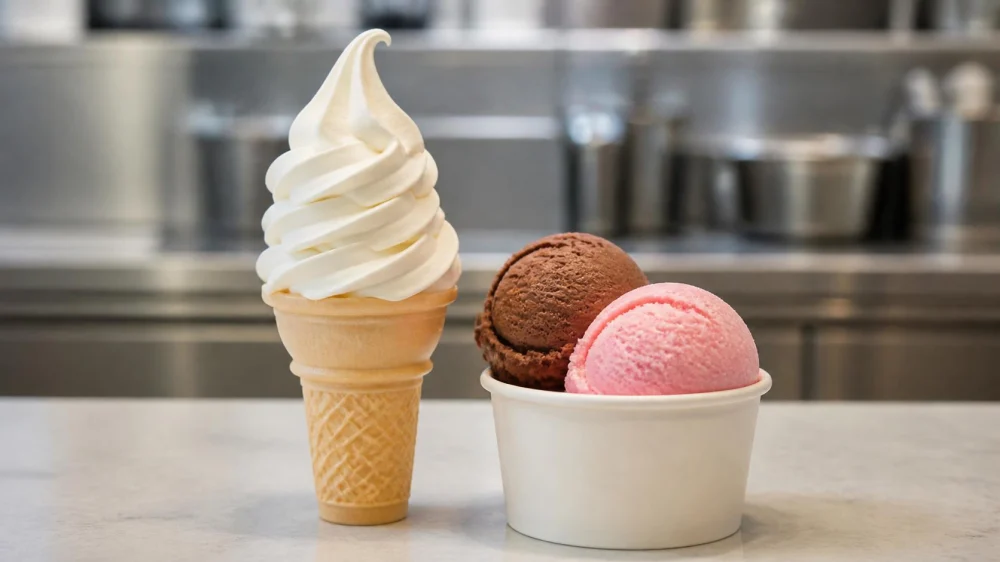
Soft serve is dispensed directly from a freezing machine at a softer temperature and usually has a light, smooth body. Hard scoop ice cream is frozen and held colder, giving it more structure and supporting dense chunks, ribbons, and stacked scoops. Choose by texture, weather, eating speed, toppings, and how far you must carry it.
Soft serve is not automatically lower in calories, fat, sugar, or allergens. The mix, portion, cone, dip, sauce, and toppings determine the full order. Ask for exact ingredient and allergen information.

Hunters' Dairy Freez / hunters dairy freez
DanvilleMontour CountyPennsylvania
1736 Montour Blvd #9117, Danville, PA 17821, USA
Why the textures differ
Temperature and incorporated air strongly affect frozen-dessert texture. A soft-serve machine freezes and aerates liquid mix as it dispenses. Hard ice cream is produced, hardened, stored, and then scooped at a lower temperature.
Recipe solids, fat, sugar, stabilizers, and equipment settings matter too. One shop’s soft serve may feel dense while another’s is airy; hard-scoop flavours may range from smooth to heavily textured.
Frozone - House of Gelato / frozone - house of gelato
2167 N Pontiac Trail, Commerce Township, MI 48390, USA
Cones, cups, and toppings
Soft serve creates a tall spiral that pairs well with simple sauces, sprinkles, or a shell dip, but heavy toppings can make it lean. A cup is easier for children, hot weather, mobility needs, or a slow eater.
Hard scoops hold chunks and layered flavours more securely. Ask for toppings beneath and above scoops if you want them in every bite. Choose a wide cup for multiple textures rather than overloading a cone.
Plan for melting
Soft serve begins softer and may lose shape quickly in sun, wind, or a warm car. Order after everyone is ready, use a cup or dish for travel across a patio, and keep napkins ready. Never place the cone on a dirty surface while organising belongings.
Hard scoop may travel slightly better but still requires prompt eating or insulated transport. A large stack can slide before it visibly melts, especially when flavours have different hardness.
Check ingredients and allergens
Both formats may contain milk, egg, soy, wheat, nuts, or other allergens. Cones, cookie pieces, sauces, dips, and toppings add separate ingredients. A shared machine, nozzle, scoop, topping bin, or preparation surface can create cross-contact.
Ask whether ingredient documentation is current and whether staff can use a clean process. If the shop cannot meet the necessary allergy controls, choose a sealed labelled alternative.
Signs of good service
Soft serve should be dispensed from clean equipment at the shop’s intended consistency. A product that is suddenly runny, icy, oddly coloured, or off-smelling should be reported rather than eaten. Staff should follow cleaning and temperature procedures.
Hard-scoop cabinets should keep tubs protected and utensils handled hygienically. Excessive frost, melted edges, dirty water, or scoops stored improperly are reasons to ask questions or choose another shop.
Take-home limits
Soft serve is designed for immediate service. A lid does not turn it into a stable transport product. If a shop offers packaged soft serve, follow its specific storage directions and get it into a freezer quickly.
For hard ice cream, use an insulated bag or cooler for the drive. If it melts substantially, do not rely on refreezing to restore quality or safety. Follow shop and food-safety guidance.
Ordering checklist
- Choose cup or cone based on heat and eating speed.
- Ask about mix, cone, sauces, and toppings.
- Verify allergy controls for every component.
- Order only when ready to eat.
- Use a cup for heavy toppings or mobility.
- Report unusual texture, odour, or equipment hygiene.
- Use insulated transport for take-home hard ice cream.
Frequently asked questions
Is soft serve just melted ice cream?
No. It is formulated and frozen for dispensing at a softer temperature.
Does soft serve have less dairy?
Not necessarily. Check the exact mix.
Which is better in hot weather?
A cup of either is easier; soft serve may lose shape sooner.
Can soft serve contain egg?
It can. Verify the ingredient statement.
Why is hard ice cream difficult to scoop?
Low temperature, recipe, and storage conditions affect hardness.
Can I take soft serve home?
It is best eaten immediately unless the shop offers a specific packaged product.
Sources and evidence notes
The shop’s current mix specification, ingredient statement, allergen documentation, food-safety plan, and equipment instructions are the primary sources for a particular soft-serve or hard-scoop product.
Local health codes govern food holding, equipment sanitation, employee practices, and inspection. Customers with food allergies should discuss the full order and shared equipment with trained staff.
Conclusion and next steps
Pick soft serve for an immediate light, smooth spiral and hard scoop for colder structure and complex mix-ins. Match cup or cone to the weather, verify every ingredient and cross-contact risk, order only when ready, and use proper insulated transport for packaged take-home desserts.




 Kreamy Korner4.0 (21 reviews)
 JB's Barnyard Ice Cream5.0 (183 reviews)
 Magic Twist Shop4.0 (14 reviews)
 Carvel4.0 (257 reviews)
 Ralph's Italian Ices5.0 (6 reviews)
 Dixie Dairy Dreem4.0 (587 reviews)
 How to Make Ice Cream with Pitaya (Dragon Fruit) for a Vibrant Pink
 Best Ice Cream Shops in Albuquerque for Green Chile Chocolate Swirls
 Best Ice Cream Shops in Nantucket for Massachusetts Whaling History
 Why Ice Cream is the Perfect Dessert for Every Season
 What Is Butterbeer Ice Cream and How to Make It Harry Potter Style
 Ice Cream and Identity: How Ice Cream Reflects Personal and Cultural Tastes