
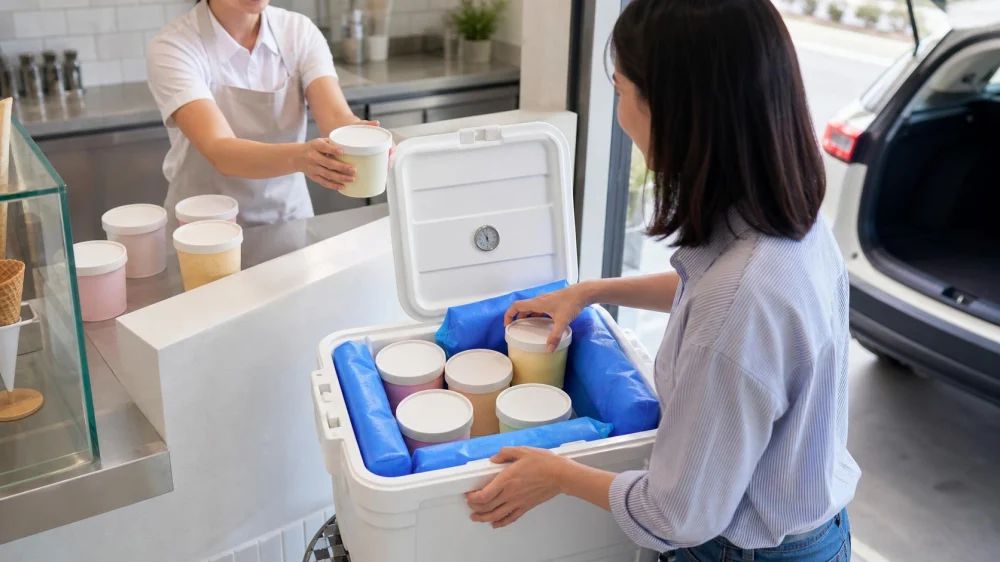
How to Transport Ice Cream Home Without It Melting
On this page
Quick answer
Buy ice cream last, place it immediately in a pre-chilled insulated cooler packed tightly with frozen gel packs or bagged ice, and drive directly home with the cooler in the air-conditioned passenger compartment. Keep the lid closed and transfer the containers straight to a working freezer. If ice cream becomes fully soft or melted and its safe temperature history is uncertain, discard it rather than refreezing it.
Dairy Queen (Treat) / dairy queen hamburg ny
250 Lake St, Hamburg, NY 14075, USA
Prepare before buying
- Freeze enough gel packs at least the day before.
- Use a clean hard-sided or thick insulated cooler sized close to the order.
- Pre-chill the cooler with ice or cold packs, then remove meltwater before loading packaged food.
- Bring clean towels or insulated filler to reduce empty warm air space.
- Plan the direct route and avoid errands after pickup.
- Confirm the home freezer has space and is operating properly.
Pack the cooler
- Ask the shop to keep the order frozen until you are ready to leave.
- Place a cold source below and around the containers, not only on top.
- Keep lids upright and tightly closed; protect paper tubs from meltwater.
- Fill gaps with additional frozen packs or clean insulation.
- Add a cooler thermometer when the trip is long or conditions are hot.
- Close the lid fully and do not reopen it to check texture during travel.
Separate ice cream from raw meat, leaking groceries or other contamination. Do not put loose unpackaged ice directly against a paper container.
Abe's Old Fashioned Frozen Custard / abe's old fashioned frozen custard
New WilmingtonLawrence CountyPennsylvania
936 PA-18, New Wilmington, PA 16142, USA
Handle the trip home
Keep the cooler inside the climate-controlled cabin rather than a hot trunk or pickup bed when it can be secured safely. Shield it from direct sun and keep it level so containers do not tip.
Travel time is not the only variable: outside heat, vehicle temperature, cooler insulation, starting temperature, package size and cold-source quantity all matter. A short delay in a parked hot car can be more damaging than a longer air-conditioned drive.
What to do on arrival
- Carry the cooler directly to the freezer before unloading other purchases.
- Inspect for leaking lids, collapsed containers and obvious full melting.
- Place tubs in the cold interior of the freezer, not a frequently opened door shelf.
- Allow softened-but-still-safe product to firm without repeated opening.
- Clean and dry the cooler and refreeze packs for the next trip.
Judge soft or melted ice cream
Texture damage and food safety are separate. Partial softening can produce large ice crystals and a grainy result after refreezing even when the product stayed cold. Complete melting creates greater quality and handling concerns.
USDA advises disposing of soft or melted ice cream for quality. If the product has been warmer than 40°F for more than two hours—or more than one hour when conditions are above 90°F—discard it. When time or temperature is unknown, do not taste it to decide.
Dry ice precautions
Dry ice can keep products very cold but can cause severe cold burns and releases carbon dioxide gas. Use it only when the cooler and transport method permit it. Wear insulated gloves, keep ventilation, never seal it in an airtight container, and do not store it in an occupied unventilated vehicle.
Keep dry ice away from children, pets and direct contact with food containers that could crack. Ask the seller for quantity and handling instructions for the route; ordinary gel packs are simpler for many local trips.
Pickup checklist
- Ice cream is the final stop.
- Cooler is clean, pre-chilled and shaded.
- Enough frozen packs surround the entire order.
- Containers are upright, closed and protected from water.
- Direct route is ready; no extra errands planned.
- Vehicle cabin is cool and cooler is secured.
- Home freezer is ready for immediate transfer.
- Time and temperature will be used—not taste—to judge uncertain product.
Limitations and important notes
This general U.S. guide applies to commercially prepared frozen desserts. Dairy-free, egg-containing, soft-serve, homemade and medically specialised products can have different formulation and handling needs. Follow the maker's label and shop guidance.
Do not serve questionable melted product to children, older adults, pregnant people or anyone with a weakened immune system. When food safety is uncertain, discard it.
Frequently asked questions
Will a thermal grocery bag work?
It may suit a very short trip with enough frozen packs, but a hard-sided, well-packed cooler offers more insulation and protection in heat.
Should I put the cooler in the trunk?
A trunk can become hot. A safely secured cooler in the air-conditioned passenger area is generally better when space and vehicle safety allow.
Can I refreeze slightly soft ice cream?
If it remained safely cold, refreezing may be possible but texture can worsen. USDA advises discarding soft or melted ice cream for quality; discard whenever temperature history is unsafe or unknown.
Does salt make cooler ice colder?
Salt can change the ice-water temperature but also creates messy brine that can damage paper tubs. Use sealed gel packs or protected bagged ice for straightforward transport.
How can I transport several pints?
Pre-chill a correctly sized cooler, pack the pints tightly in layers of cold sources and minimise empty space. Confirm the lid closes fully.
Sources and evidence notes
USDA Food Safety and Inspection Service freezing and food-safety guidance uses 40°F as an important cold threshold, explains safe refreezing conditions for many foods and advises disposing of soft or melted ice cream for quality. Package and shop handling instructions take priority.
Next steps
Freeze the cold packs, clear freezer space and place the cooler in the car before ordering. At pickup, load the ice cream last and drive directly home. Transfer it first, then record which cooler setup worked so the next frozen-dessert trip is easier.

 What's The Scoop4.0 (389 reviews)
 Dairy Queen4.0 (578 reviews)
 Pop's Old Fashion Ice Cream Co4.0 (825 reviews)
 Praline's Cafe4.0 (137 reviews)
 The Bold Face Dairy Bar4.0 (228 reviews)
 Dre's Water Ice and Ice Cream (Mobile Truck)4.0 (54 reviews)
 How to Make Ice Cream in 10 Minutes or Less | Ice Cream Shop
 Best Ice Cream Shops in St. Louis for Missouri Gooey Butter Cake Scoops
 Best Ice Cream Shops in Philadelphia for Liberty Bell Shaped Cones | Ice Cream Shop
 Comparison of Low-Calorie Ice Cream Brands like Halo Top and Nick’s
 Ice Cream Making 101: Everything You Need to Know to Get Started
 Ice Cream and Memes: The Internet’s Favorite Frozen Dessert Jokes