
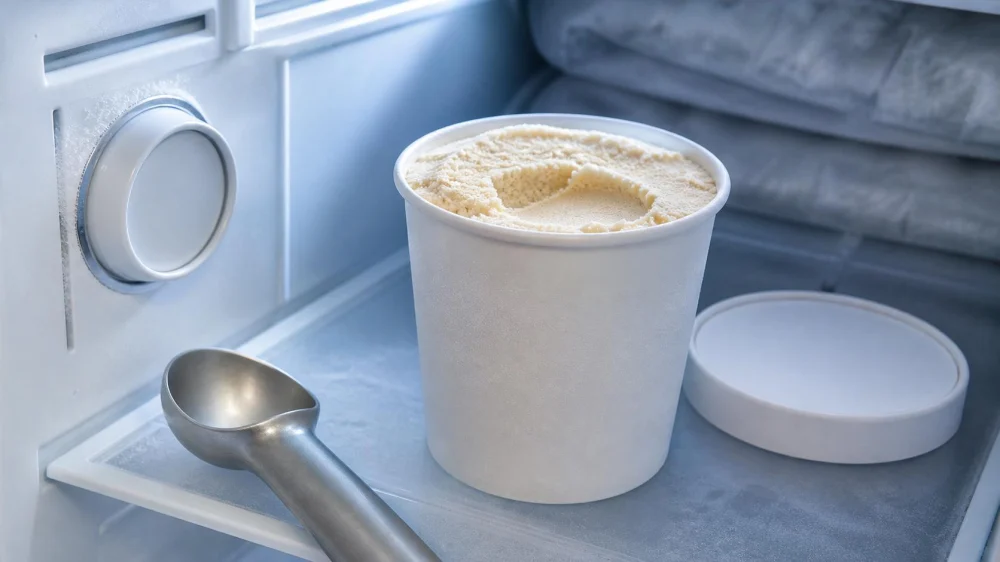
Icy Ice Cream: What Texture Changes Can Tell You
Table of contents
Quick answer
Large ice crystals usually signal texture damage from slow freezing, air exposure, age, or temperature swings. A thin icy surface is mainly a quality problem, but melted or poorly temperature-controlled ice cream should not be judged safe by appearance or taste. Keep it at 0°F (-18°C) or below, limit time out of the freezer, and discard soft or melted ice cream after a power interruption.

Guernsey Crest Ice Cream Co / guernsey crest ice cream
PatersonPassaic CountyNew Jersey
134 19th Ave, Paterson, NJ 07513, USA
Why crystals grow
Ice cream contains many small ice crystals, air cells, fat, sugar, and water. Smooth texture depends partly on keeping those crystals small. When the product warms and cools repeatedly, some ice melts and then refreezes onto remaining crystals. Air exposure also dries the surface and encourages frost.
Common triggers include a loose lid, storage in the freezer door, repeated scooping sessions, a warm trip home, or an overfilled or failing freezer. Crystals do not automatically mean the shop made the ice cream incorrectly.

TLC Polish Water Ice / polish water ice ocean city md
Ocean CityWorcester CountyMaryland
101 N Atlantic Ave, Ocean City, MD 21842, USA
Quality versus safety
Freezer burn and surface frost can make ice cream dry, grainy, or less flavourful without necessarily making a continuously frozen product unsafe. Safety is different: it depends on temperature history, contamination, and handling. Never taste an uncertain product to decide whether it is safe.
USDA guidance says to dispose of soft or melted ice cream after a freezer failure for quality reasons, and FoodSafety.gov lists ice cream and frozen yoghurt for disposal after a power outage rather than refreezing. When the history is unknown, the safer decision is to discard it.
Store a pint better
- Take frozen purchases home promptly in an insulated bag, especially in hot weather.
- Place the container in the cold main compartment, not the door.
- Keep the freezer at 0°F (-18°C) or below and use an appliance thermometer.
- Scoop with a clean utensil, close the lid firmly, and return the pint quickly.
- Press a clean food-safe barrier against the surface only if the maker recommends it.
- Do not repeatedly soften the entire container to make scooping easier.
After a power outage
Keep the freezer door closed and use an appliance thermometer if available. General refreezing rules that apply to meats or vegetables should not be assumed to apply to ice cream. FoodSafety.gov’s outage chart says to discard ice cream and frozen yoghurt. Clean any leaks so they do not contaminate other foods.
Limitations
Appearance cannot reconstruct a product’s temperature history or identify pathogens. Formulas also vary: gelato, dairy-free desserts, low-sugar products, and high-overrun ice creams soften and crystallise differently. Follow package instructions and local public-health advice when a recall or outage affects the product.
FAQ
Can I scrape off the icy top?
You can remove a poor-quality surface from a product known to have stayed frozen, but that does not rescue ice cream with an uncertain temperature history.
Why is the shop scoop smoother than my stored pint?
Commercial serving cabinets, rapid turnover, formulation, and controlled scooping temperature can all affect texture.
May I microwave the pint briefly?
Follow the maker’s directions. Uneven warming can melt edges while the centre remains hard and can worsen refreezing texture.
Is frost outside the sealed container a problem?
It may come from freezer humidity or another spill. Inspect the seal and package; contact the seller if it is damaged.
Sources and evidence notes
- USDA FSIS: Freezing and Food Safety — freezer temperature, crystal formation, and melted ice cream guidance.
- FoodSafety.gov: Food Safety During a Power Outage — discard guidance for ice cream and frozen yoghurt.
Next steps
Use an insulated bag for the next pickup, verify that the home freezer holds 0°F (-18°C) or below, store pints away from the door, and return them promptly after scooping. Discard melted product when its temperature history is uncertain.


 Pufferbelly Ice Cream5.0 (103 reviews)
 Rita's Italian Ice & Frozen Custard4.0 (388 reviews)
 Luna Gelato and Ice Cream3.0 (10 reviews)
 Village Sundaes5.0 (20 reviews)
 Cold Stone Creamery3.0 (152 reviews)
 Bulldog Ice Cream4.0 (569 reviews)
 Best Ice Cream Shops in Aberdeen for Washington Coastal Cranberries
 Best Ice Cream Shops in Honolulu for Haupia (Coconut Pudding) Flavors
 Best Ice Cream Shops in Newport for Oregon Coast Aquarium Themes
 Ice Cream Too Hard? Soften It Without Ruining the Pint
 Ice Cream for Dogs: Safe Recipes and Store-Bought Brands
 Ice Cream Sample Spoons: Ask, Taste, and Avoid Mix-Ups