
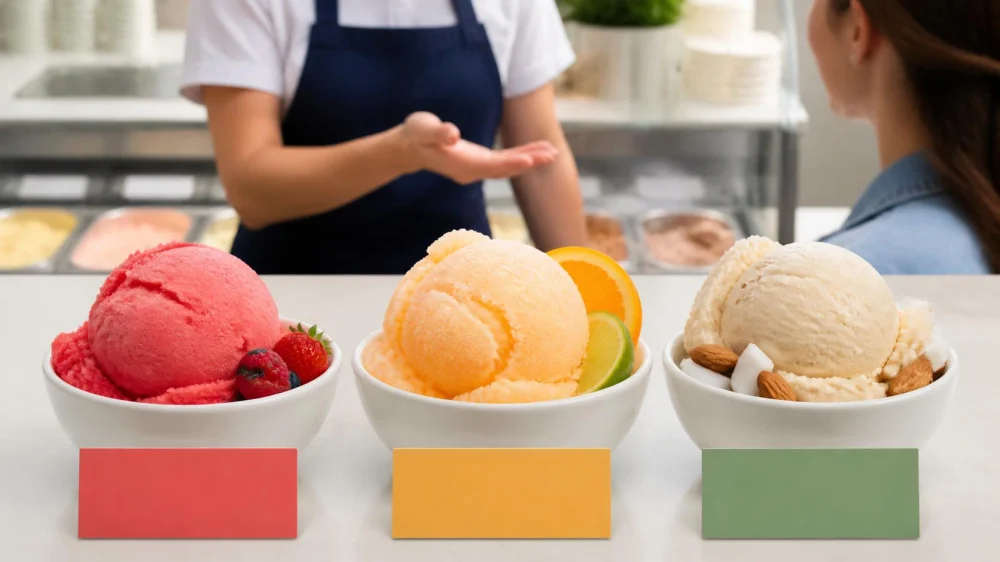
Sorbet, Sherbet, or Dairy-Free? Read Beyond the Name
On this page
Quick answer
Sorbet is commonly fruit-and-water based, sherbet commonly includes some dairy, and 'dairy-free' describes an ingredient boundary rather than one texture. None of these names proves a product is safe for an allergy, vegan, gluten-free, low-sugar, or made without shared equipment. Ask about the exact recipe, stabilisers, mix-ins, serving tools, and cross-contact at that location.

Kool Cones of North Park / kool cones north park
GibsoniaAllegheny CountyPennsylvania
1330 Wildwood Rd, Gibsonia, PA 15044, USA
Why it matters
Sorbet, sherbet, and dairy-free frozen desserts are menu categories with overlapping flavours but different bases. Sorbet tends to be icier and fruit-forward; sherbet often has a small dairy component; dairy-free products may use nuts, coconut, oats, soy, or other bases.
This U.S. guide helps customers compare menu language. Legal labelling and shop recipes vary, and display signs may be shortened for space. Ingredient and allergen confirmation must come from current product information and staff procedures.

Wares Bros Frosty Treat / wares bros frosty treat
Traverse CityGrand Traverse CountyMichigan
1409 W South Airport Rd, Traverse City, MI 49686, USA
Practical checklist
- Ask whether the item contains milk, cream, whey, casein, egg, gelatine, honey, alcohol, nuts, soy, wheat, or other relevant ingredients.
- Confirm whether 'dairy-free' applies to the base only or the complete flavour with mix-ins.
- Ask how scoops, spades, tubs, blenders, and display wells are shared and cleaned.
- Compare texture: icy and refreshing, soft and slightly creamy, or rich plant-based.
- Check fruit seeds, peels, acidity, added pieces, and sauces for preference or health needs.
- Use a clean sample process only when the shop can support it.
- Choose a sealed labelled product when strict verification cannot be provided.
Step-by-step plan
- Define the reason for choosing the category: flavour, texture, vegan preference, lactose avoidance, milk allergy, or another need.
- Read the full flavour description. A sorbet with cookie pieces or a dairy-free base with caramel may add unexpected ingredients.
- Ask the boundary question clearly. 'Does the complete product contain milk ingredients, and how is cross-contact handled?' is more useful than 'Is this safe?'
- Compare texture and sweetness by small sample if allowed, using a fresh spoon and avoiding contact with the display.
- Check plant bases. Nut, soy, oat, or coconut ingredients solve some needs but create others and can change flavour and mouthfeel.
- Confirm serving tools. A fresh scoop from a new tub may reduce some contact, but the shop must decide what controls it can reliably provide.
- Order with limits in mind. When the answer is incomplete, choose a simpler packaged alternative or do not order.
For strict dietary needs, keep a photo or manufacturer page for the exact flavour and date, while recognising that formulations and shop procedures can change.
Limits and warning signs
Lactose-free is not the same as milk-free, vegan claims do not automatically establish allergy safety, and colour cannot reveal dairy or sugar. Frozen-dessert names may be used informally on local menus.
For a severe allergy, avoid products when ingredient or cross-contact information is uncertain. Follow the personal emergency plan and seek urgent help for breathing difficulty, throat or facial swelling, faintness, widespread hives, or rapid worsening.
Frequently asked questions
Does sorbet always contain no dairy?
Often it is fruit-and-water based, but recipes and mix-ins vary. Verify the exact flavour.
Is sherbet the same as sorbet?
No. Sherbet commonly includes some dairy and has a slightly creamier texture, while sorbet usually does not.
Does dairy-free mean vegan?
Not necessarily. Egg, honey, gelatine, or other animal-derived ingredients may still appear.
Can a clean scoop make it allergy-safe?
It may reduce one contact source but cannot address every shared tub, well, blender, or ingredient issue. Ask the shop what it can guarantee.
Sources and evidence
The guide reflects common frozen-dessert definitions, ingredient-label reading, and food-allergy communication: identify the complete recipe, distinguish preference from medical need, ask about shared equipment, and choose a verifiable alternative when uncertain.
Conclusion and next steps
Start with why the category matters to you, then ask about the full flavour—not just the base. Confirm milk and other relevant ingredients plus serving-tool contact. Choose texture by preference only after the ingredient boundary is clear.



 Lou’s soda fountain3.0 (2 reviews)
 Baskin-Robbins3.0 (70 reviews)
 The Frozen Boulder-Yorktown4.0 (56 reviews)
 Whits Frozen Custard of Waverly,Ohio4.0 (299 reviews)
 Heartland Homemade Ice Cream4.0 (158 reviews)
 Deb's Soft Kreme4.0 (397 reviews)
 Best Ice Cream Shops in St. Augustine for Florida Spanish Colonial History
 Ice Cream Pairings: What Goes Best with Your Favorite Flavors
 Best Ice Cream Flavors for the Health Conscious
 What Is Hot Chocolate Ice Cream and How to Add Marshmallow Swirls?
 How to Make Homemade Gelato with Simple Ingredients: Complete U.S. Guide
 Ice Cream Innovation: New Freezing Technologies and Methods for Better Flavor and Texture